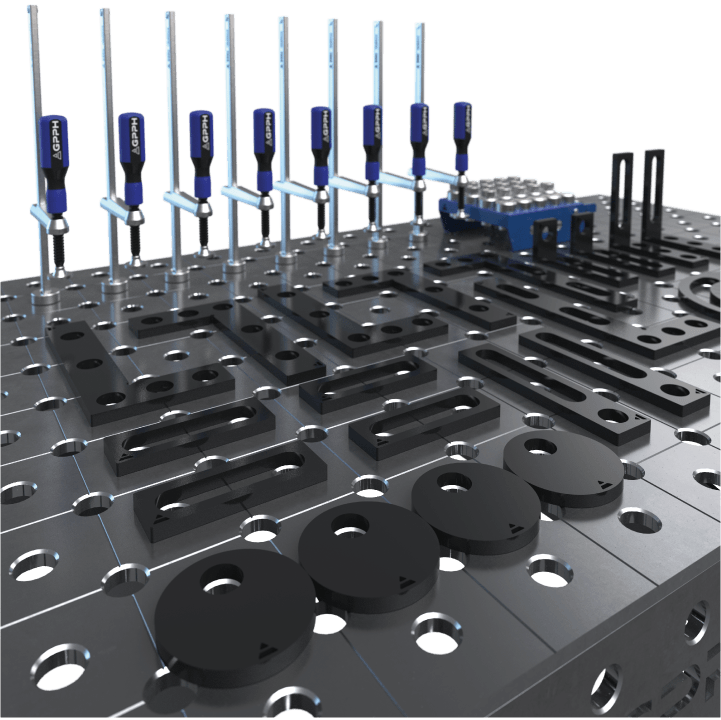


You can have an experienced welder. You can work with high-quality material. You can use proven tools.
And yet, after assembly, the structure does not hold its angle, “shifts” along the diagonals, or requires corrections. In such situations, we most often look for the problem in the welding technology, current parameters, or the sequence of tack welds. Meanwhile, very often the source of the problem is much closer - in the very foundation of the entire process. In the welding table.
And more precisely: in one detail.
Table flatness - the foundation of geometry
The most important element of a welding table is its flatness. It determines whether the structure will be assembled in perfect geometry already at the assembly stage.
If the tabletop has deviations, even minimal ones, the components are slightly “forced” during clamping. The clamps press the part against a surface that is not perfectly flat. As a result, stresses appear in the structure even before the first weld is made. Once the clamps are released, the structure returns to its natural position - and suddenly it turns out that the angle is no longer 90° and the diagonals do not match.
In professional welding tables, the flatness tolerance is as low as ≤0.15 mm across the entire tabletop surface. For many people, it is just a detail. In practice, it is the difference between a repeatable structure and one that requires corrections.
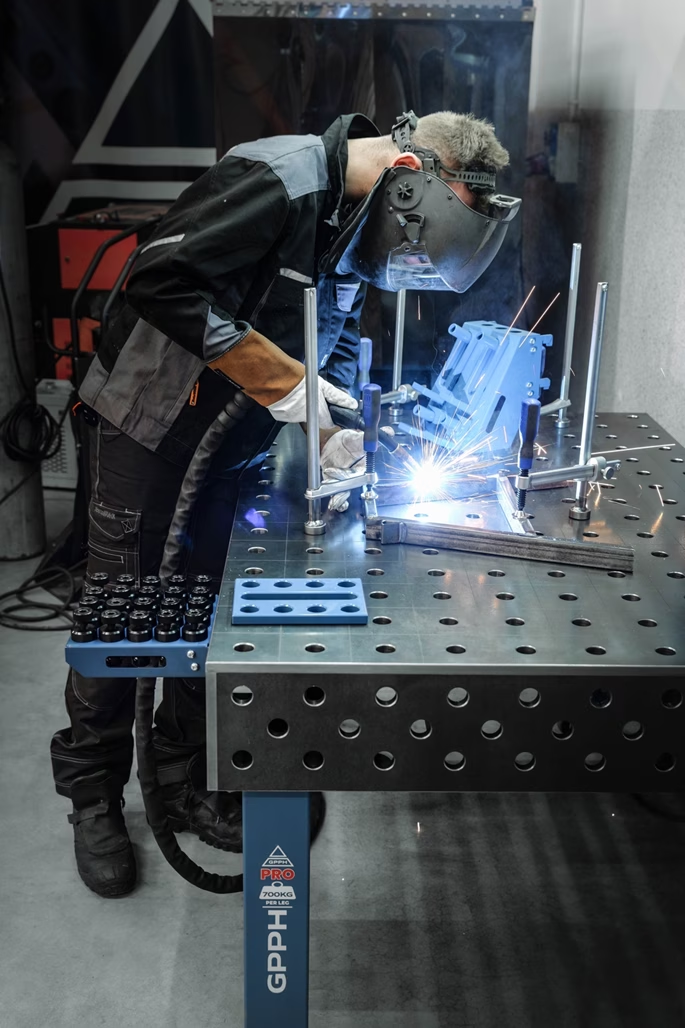
Why do a few tenths of a millimeter matter?
With a small component, the difference may be negligible. But in a structure measuring 2-3 meters in length, a slight unevenness at one point can translate into several millimeters of deviation at the other end. In custom production, this means extra time. In serial production - real financial losses.
That is why a welding table cannot be just “straight enough.” It must be precise.
System holes - the second key element
The second detail that has a huge impact on the geometry of a structure is the system holes. They allow tools, bolts, and clamps to be positioned accurately. If the holes are not made with sufficient precision, the tools do not work on-axis. Micro-shifts occur, and with a larger number of reference points, they begin to accumulate.
Precisely milled and chamfered holes in ⌀16 or ⌀28 systems (in a 50x50 mm, 100x100 mm, or diagonal grid) guarantee that every component has its exact place. And this translates directly into production repeatability.
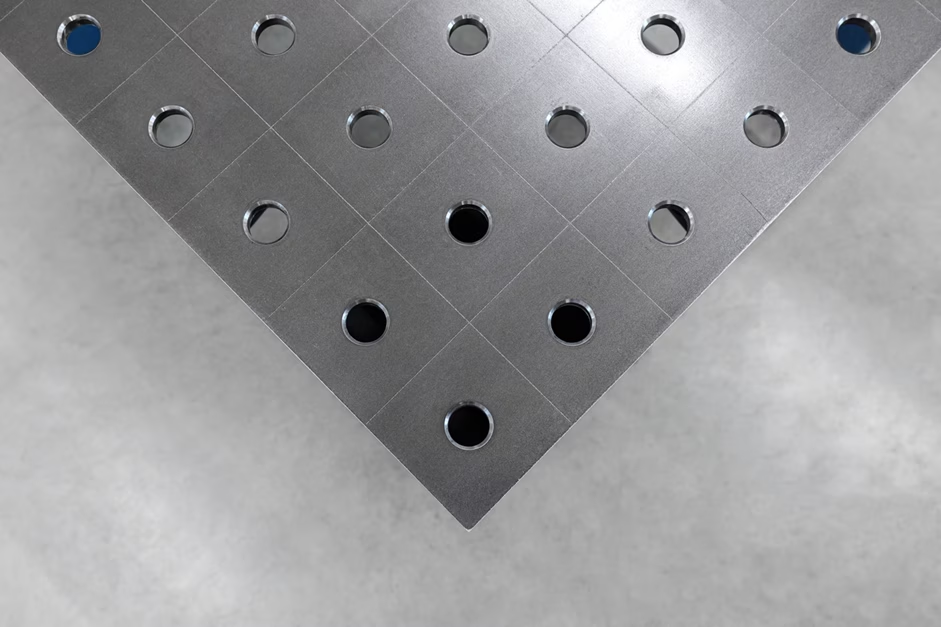
Table structure rigidity
Even a perfectly flat tabletop is not enough if the entire table structure flexes under load. During the assembly of larger components, under strong clamp pressure, or with heavy structures, a weaker table can deform slightly. This is often invisible to the naked eye, but the final result is noticeable.
That is why proper ribbing, tabletop thickness, and stable leg profiles are so important. The table must be a base that does not change its geometry during operation.
Why is it so important in modern manufacturing?
Modern welding is no longer just craftsmanship - it is a repeatable technological process. Structures are increasingly moving to further stages of machining, robotic automation, and serial assembly. If the foundation is inaccurate, every next stage will generate problems. That is why precision starts not with the weld, but with the table.
A good welding table:
- maintains stable flatness,
- guarantees the accuracy of the hole system,
- provides adequate load capacity and rigidity,
- ensures dimensional repeatability.
Precision starts with the foundation
At GPPH, we treat the welding table as the foundation of the entire production process. It is not an addition to the workstation - it is its most important element.
If the structure is not coming out straight, before changing the welding technology, check the foundation. Sometimes it is this one detail - the flatness and precision of the tabletop - that determines whether the structure will be perfect or will require corrections.
Because in welding, everything starts with geometry. And geometry starts with the table.