


Welding fumes appear practically immediately after work begins. At first, they are visible above the workstation, a moment later they rise higher, and during intensive welding they can spread throughout the entire hall. Opening a gate or window may temporarily improve the situation, but it is difficult to consider this an effective way of removing welding fumes.
So what should be done? It is best to capture the pollutants as close as possible to the place where they are generated and then filter them out. In larger halls, it may also be necessary to clean the air that is already present throughout the entire space.
And this is exactly where the topic of properly selected welding filtration and ventilation begins.
How to effectively remove welding fumes?
The most important rule is simple: the sooner the fumes are captured, the less time they have to spread throughout the workshop.
Therefore, for a fixed or single workstation, it is worth using a welding fume extraction system positioned directly next to the place where the weld is being made.
An example of such a solution is the IQ Aero Clean ECO from GPPH. It is a mobile extraction unit designed for workshops and small and medium-sized facilities. The device can be easily moved between workstations, while versions with one or two arms allow it to be adapted to the way of working.
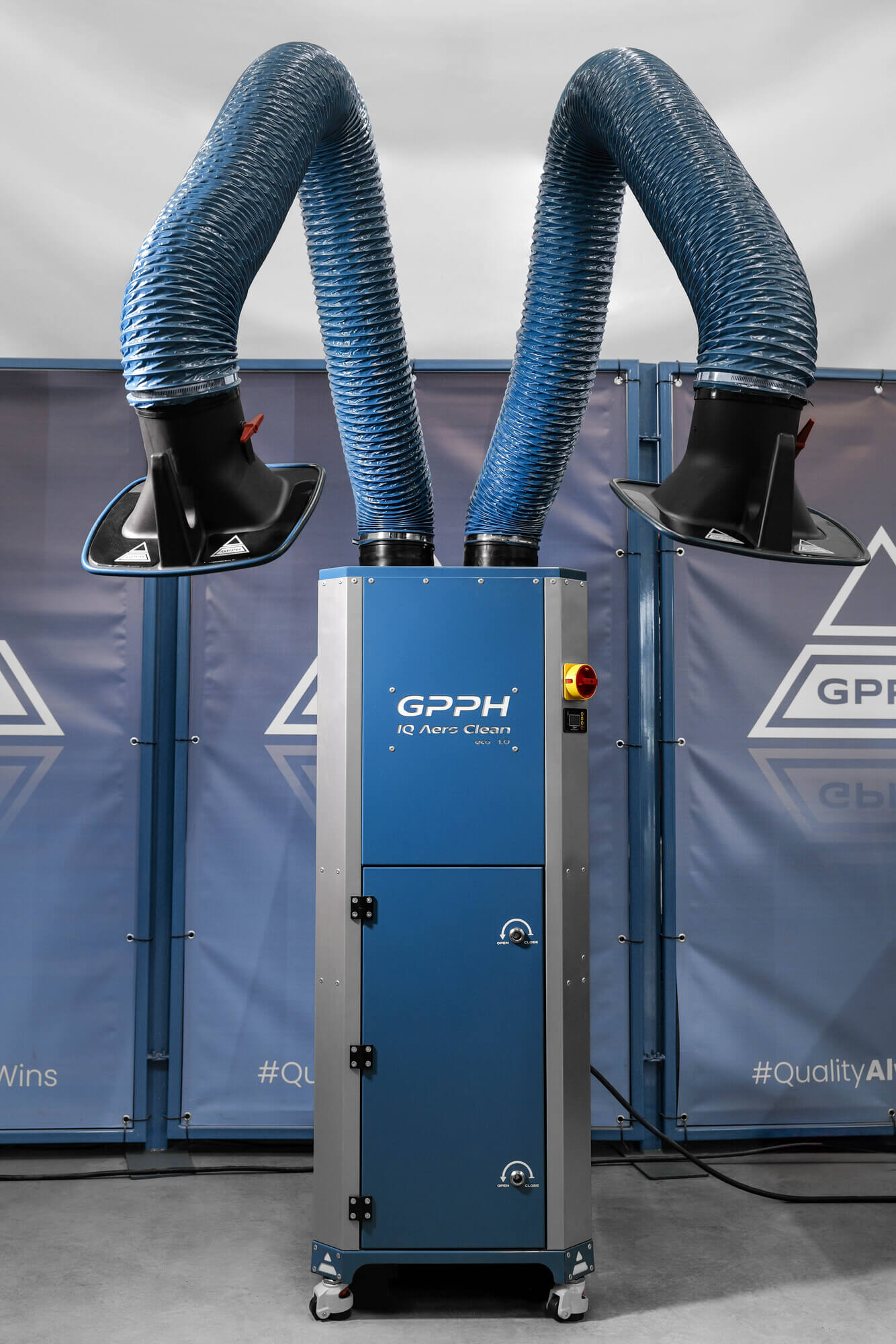
ECO achieves an airflow of 1200 m³/h and uses two-stage filtration – a spark arrestor filter and a cartridge filter. It is a good solution where there is no need to build an extensive central installation.
Mobile welding fume extraction system or wall-mounted unit?
If the workstations frequently change location, a mobile welding fume extraction system will be more practical.
In addition to ECO, Our offer includes IQ Aero Clean Mobile with a capacity of 3000 m³/h. The ability to move the unit makes it possible to adapt the filtration and ventilation system to the current work layout.
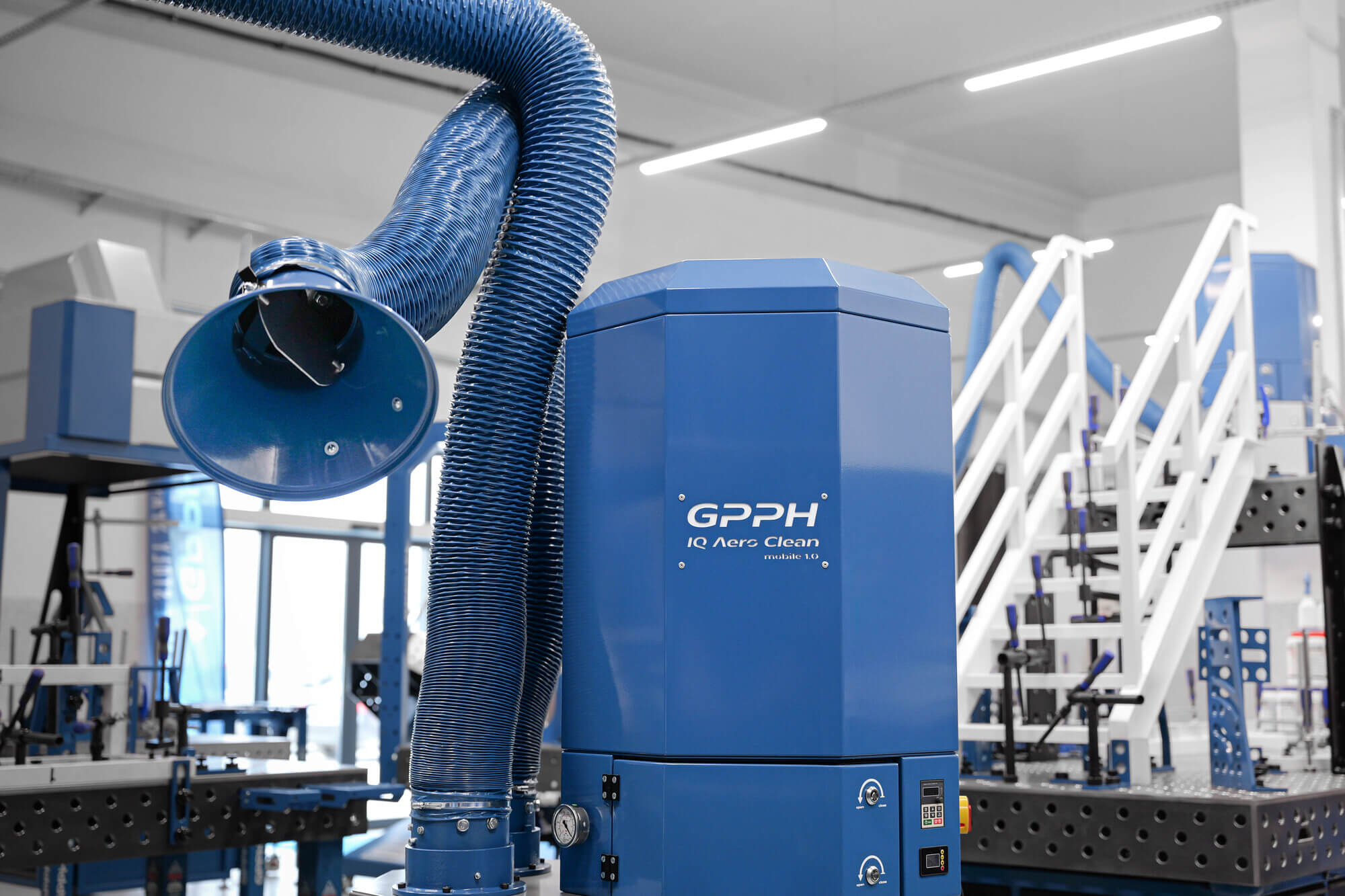
If, however, welding is carried out continuously in the same place, it is worth considering IQ Aero Clean Wall. The unit is mounted on the wall, so it does not take up floor space. The available variants allow one or two workstations to be served.
There is therefore no single answer to the question of which extraction system is better. \Mobile provides flexibility, Wall works well at a fixed workstation\, while ECO will be an economical solution where the requirements are lower.
How to set up welding fume extraction?
Simply having an extraction system is not enough. The extraction arm should be positioned as close as possible to the point where the fumes are generated.
If the suction hood is too far away, some of the pollutants may bypass the extraction zone and enter the hall. Therefore, during work, it is worth remembering to reposition the arm as the location of the weld changes.
And what if the welder works across the entire surface of a large table and constantly moving the arm is inconvenient?
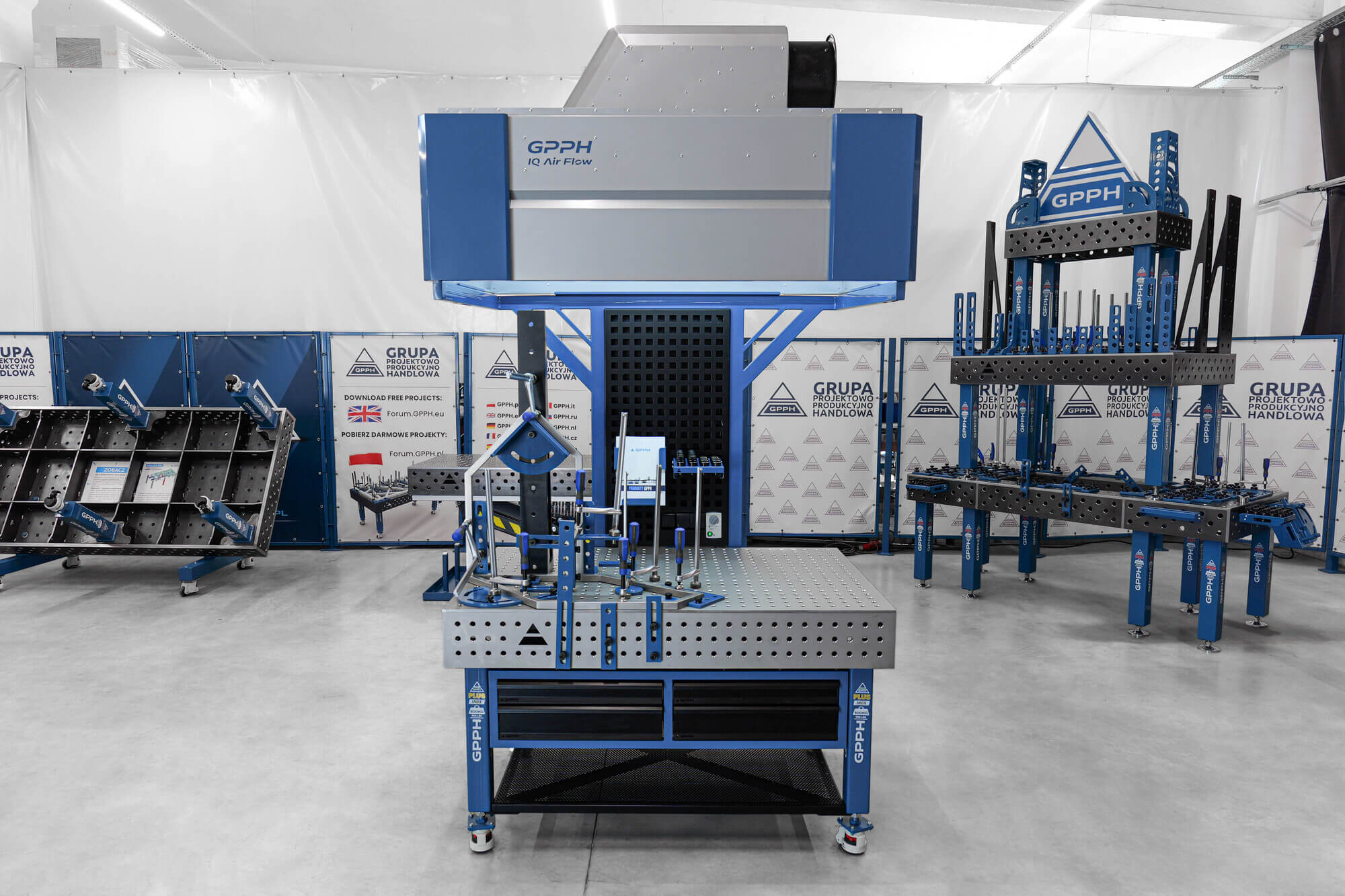
In that case, an alternative may be IQ Air Flow – a welding extraction hood that removes fumes from the entire surface of the table, including its corners. It can operate with a fan or be connected to an existing ventilation system.
What to do with welding fumes in a large hall?
The problem becomes greater when several or a dozen or so workstations operate at the same time. Then, instead of selecting additional individual devices, it is worth looking at the filtration and ventilation of the entire facility.
For such applications, we offer IQ Aero Clean MASTER – a central filtration and ventilation unit with a capacity of 15 000 m³/h, designed for intensive operation and installations with multiple extraction points.
MASTER therefore makes it possible to capture pollutants directly from multiple locations where they are generated.
But this is not possible in every hall.
Jak oczyścić powietrze w hali bez instalacji kanałowej?
Stanowiska mogą być mobilne, produkowane konstrukcje bardzo duże, a układ hali regularnie się zmieniać. W takich warunkach stworzenie odciągu przy każdym źródle dymu może być trudne.
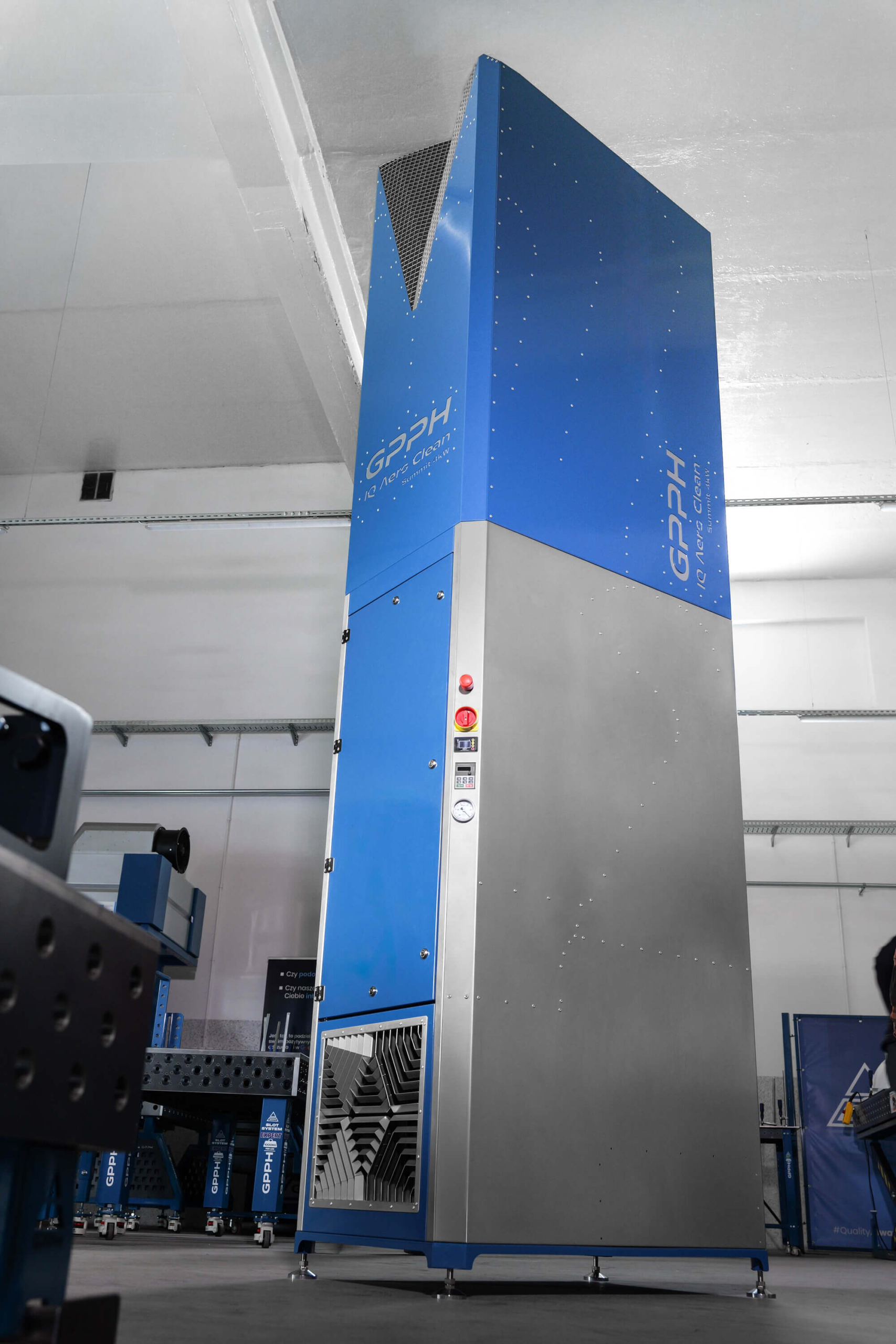
IQ Aero Clean SUMMIT is designed for this type of application.
It is an industrial filtration column with a capacity of 5000 m³/h, which operates differently from a conventional workstation extraction system. It draws contaminated air from the upper part of the hall, filters it, and then directs the cleaned air back into the working area.
Importantly, SUMMIT does not require duct installation. It can operate as a standalone solution or complement existing workstation extraction systems.
Which filtration and ventilation system should you choose for a welding shop?
A large installation is not always necessary. And conversely – one mobile extraction unit will not solve the problem of a hall where more than a dozen welders work at the same time.
Therefore, the choice can be simplified:
- ECO – a mobile extraction unit for smaller workshops and individual workstations,
- Mobile – when greater capacity and the ability to change the work location are needed,
- Wall – for fixed welding workstations,
- IQ Air Flow – when fumes are to be removed from above the table surface,
- MASTER – for installations covering multiple emission points,
- SUMMIT – for cleaning the air in a large hall without duct installation.
The most important thing, therefore, is not only the question “how to get rid of welding fumes?”, but also where this fume needs to be removed from.
From one workstation? From several workstations at the same time? Or have the pollutants already managed to spread throughout the entire hall?
Only after answering these questions can the appropriate welding fume extraction system or filtration and ventilation system be selected. Our offer has been built in exactly this way – from simple workstation units to solutions designed for large production plants. This makes it possible to adapt the filtration and ventilation system to the actual problem, instead of trying to adapt the problem to a single device.