
The automation of welding processes is no longer the exclusive domain of large manufacturing plants. More and more companies are deciding to implement cobots, i.e. collaborative robots that can work side by side with humans. However, for such a system to be safe, efficient and truly beneficial, proper preparation of the workstation is essential. One of the key elements of a modern robotic workstation is the Rama Welding Gate – a solution that organizes the workspace and enables the safe integration of a cobot into the welding workshop.
Preparing the workshop for a welding cobot - where to start?
Implementing a welding cobot is not only about purchasing a robot, but above all about properly planning the workspace. The workstation must ensure stability, safety and repeatability of the welding process. It is necessary to designate the robot’s working zone, protect the operator and ensure proper organization of the entire workshop. Rama Welding Gate enables the creation of an organized and safe workspace adapted to cobot operation. The frame structure allows for the installation of guards, safety curtains and other OHS components required for robotic welding. As a result, the workshop is prepared both technically and organizationally.
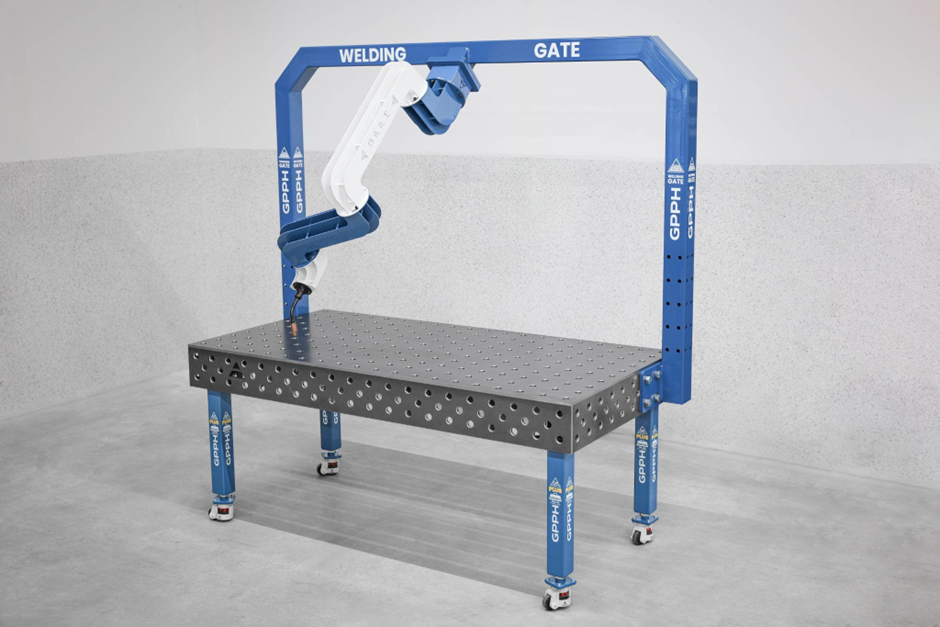
Rama Welding Gate – technical specifications and integration possibilities
The Rama Welding Gate has been designed as a component of a system-based welding workstation intended for use with cobots in combination with professional GPPH welding tables. This solution enables stable robot mounting within the workstation and its precise positioning relative to the working surface of the table, which is crucial for the repeatability of the welding process.
The Welding Gate structure fits into a system-based approach to organizing robotic welding workstations and offers:
- the possibility of mounting a cobot within the Welding Gate frame in combination with a welding table,
- compatibility with professional welding tables and GPPH clamping systems,
- a structure enabling the integration of safety elements such as guards, protective fencing or safety systems,
- an organized and ergonomic arrangement of the workspace around the cobot,
- a scalable solution that can be adapted to changing production needs.
An important aspect of working with cobots is also the proper workstation geometry. The Welding Gate frame allows the robot to be positioned relative to the welding table in such a way that the working angle and inclination of the cobot’s working axis can be adjusted to a specific welding application. This is particularly important when welding spatial components, parts with diverse geometry, and in tasks requiring access to welds from different angles. As a result, a workstation equipped with Welding Gate can be effectively used in a wide range of robotic welding applications.
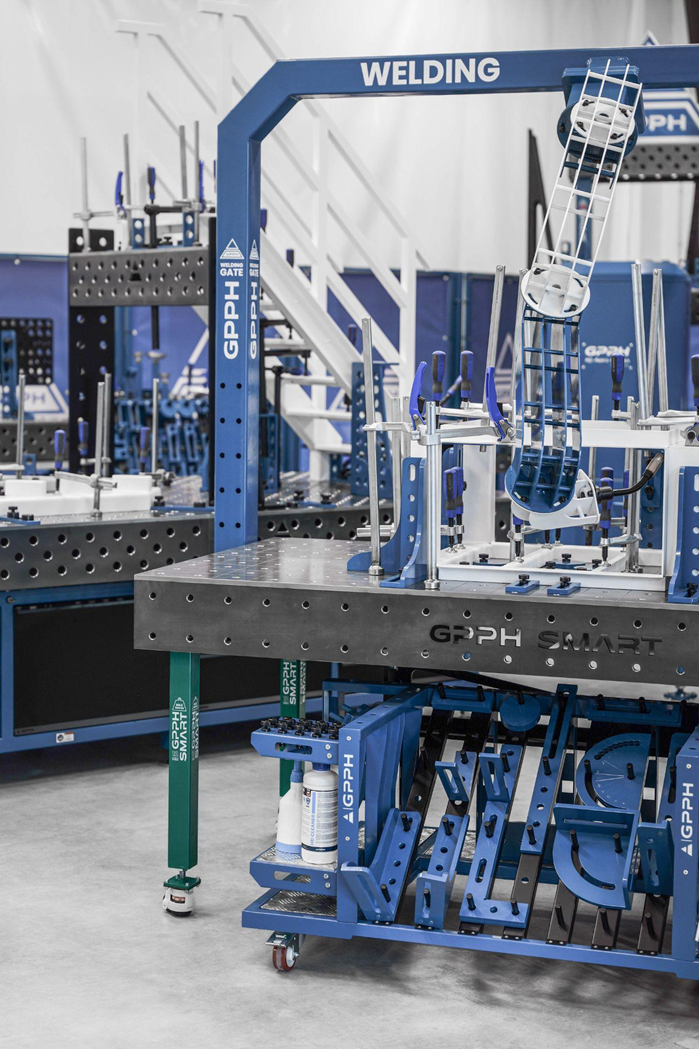
Comprehensive welding workstation with a cobot – what else matters?
Preparing a workshop for working with cobots does not end with the frame itself. Equally important is the welding table, which must ensure perfect flatness, high load capacity and compatibility with tooling systems. Operator ergonomics, easy access to tools, as well as effective ventilation and extraction of welding fumes have a direct impact on safety and working comfort. The Rama Welding Gate integrates all these elements into one coherent system. It facilitates workstation organization, improves production repeatability and makes the cobot a real support in the daily work of the workshop.
Conclusion
A well-designed workstation is the foundation of effective welding robotization. Rama Welding Gate enables safe, stable and flexible preparation of the workshop for cooperation with welding cobots. It is a solution that combines the precision of automation with the experience of a welder, increasing production efficiency and raising OHS standards in a modern welding workshop.


 Polski
 Čeština
 English (UK)
 English
 English (Australia)
 English (South Africa)
 English (New Zealand)
 Deutsch
 Deutsch (Österreich)
 Deutsch (Schweiz)
 Español
 Español de Costa Rica
 Español de Guatemala
 Español de Puerto Rico
 Español de Chile
 Español de Uruguay
 Español de República Dominicana
 Español de Perú
 Español de Colombia
 Español de Ecuador
 Español de Argentina
 Español de México
 Español de Venezuela
 Italiano
 Nederlands
 Français
 Français de Belgique
 Français (Algérie)
 Svenska
 Slovenščina
 Slovenčina
 Suomi
Suomi Norsk bokmål
 Português
 Português do Brasil
 Dansk
Dansk Eesti
Eesti Lietuvių kalba
 Latviešu valoda
 Magyar
 Română
 Türkçe
 Ελληνικά
 Українська
 Bahasa Indonesia
 Български
 Hrvatski
 Српски језик