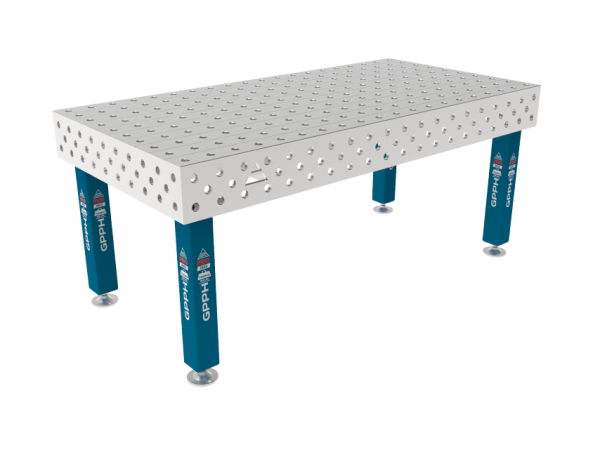
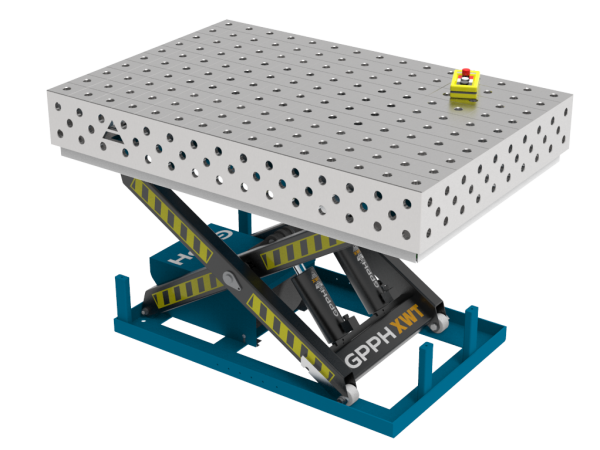
Welding Tables – Faster Setup and Repeatable Structural Geometry
GPPH Welding Tables are available from €570 net and help position workpieces faster, secure them firmly, and reduce rework caused by component movement. They are ideal for serial production, metalworking, and workshops where welding precision, ergonomics, and repeatability are essential.
Why Does a Welding Table Speed Up Workpiece Preparation?
A precision welding table shortens the marking-out and setup stage because its work surface, hole system, and engraved grid create a consistent reference system. The 100 × 100 mm grid makes it easier to verify dimensions, while stops, squares, and clamps allow workpieces to be positioned in the same way when producing subsequent parts. Repeatable clamping reduces the need for improvised fixtures and minimizes corrections between successive stages of work.
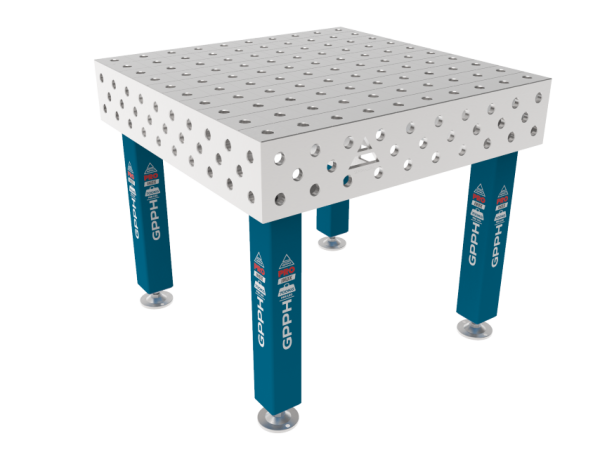
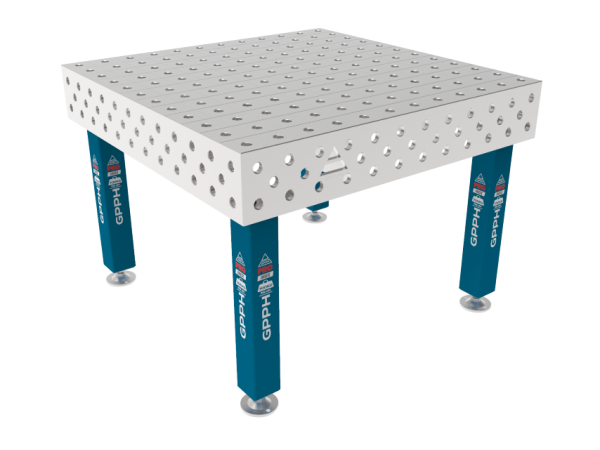
In GPPH's traditional table series, the flatness tolerance across the entire tabletop is ≤ 0.3 mm for the ECO series and ≤ 0.15 mm for the PLUS, PRO, and EXPERT series, provided the table is properly levelled. The flat working surface supports precise workpiece positioning, while the hole system ensures an organized arrangement of clamping tools.
Welding Table Tabletops – Material, Thickness and Rigidity
Standard welding table tabletops are made of S355J2+N structural steel, while the INOX variants are manufactured from 1.4301 stainless steel. Depending on the series, the tabletop thickness is 8, 12, 15, or 25 mm and primarily affects the rigidity of the working surface and its resistance to local deformation during workpiece clamping.
In traditional welding tables, ribs spaced at approximately 400 mm intervals reinforce the tabletop and help maintain the geometry of the working surface.
In the PLUS, PRO, and EXPERT series, machined and chamfered holes make it easier to insert locating pins, install tools, and remove them afterwards. Hole manufacturing tolerances are ±0.1 mm for the ECO series and +0.05 mm for the PLUS, PRO, and EXPERT series, supporting repeatable tool fitment and consistent workpiece positioning.
GPPH recommends: Before positioning your first structure, level the table across its entire surface and check the level again after moving it. The declared tabletop flatness tolerance is achieved only when all support points are properly adjusted.
16 mm or 28 mm Hole System – Which One Should You Choose?
The choice of hole system depends on the weight of the workpieces, the required density of clamping points, and the tooling you use. The 16 mm hole system is well suited for smaller components, while the 28 mm system provides a versatile foundation for heavier fabrications as well. GPPH Welding Tables are available with a 100 × 100 mm grid, a diagonal hole pattern, and, for the 16 mm system, a 50 × 50 mm grid.
16 mm Hole System for Precise Positioning
The 16 mm hole system with a 50 × 50 mm grid provides more clamping points than the 100 × 100 mm pattern. A precision welding table in this configuration makes it easier to build fixtures for small frames, metalworking components, and robotic workstations.
28 mm Hole System for Larger Structures
The 28 mm hole system is designed to work with heavier-duty tooling and larger workpieces. The engraved 100 × 100 mm grid remains a clear reference, while the diagonal hole pattern provides additional clamping positions.
How do you choose the right welding table?
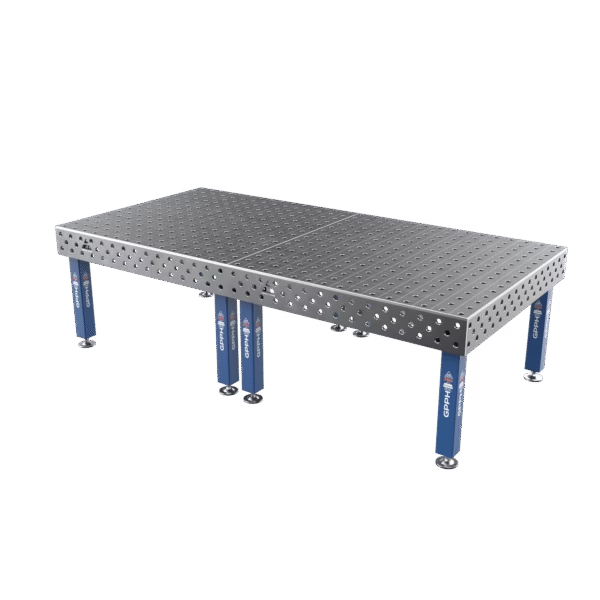
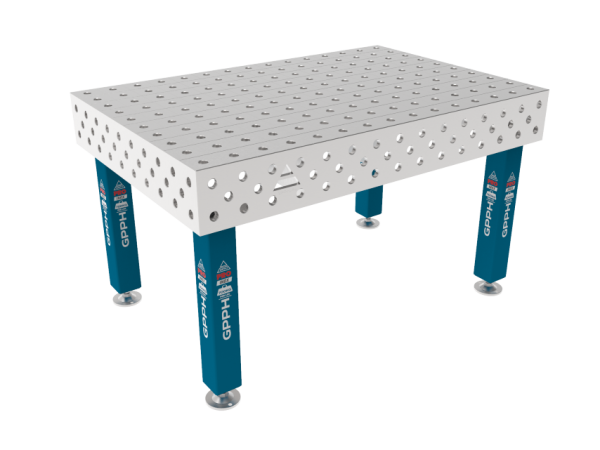
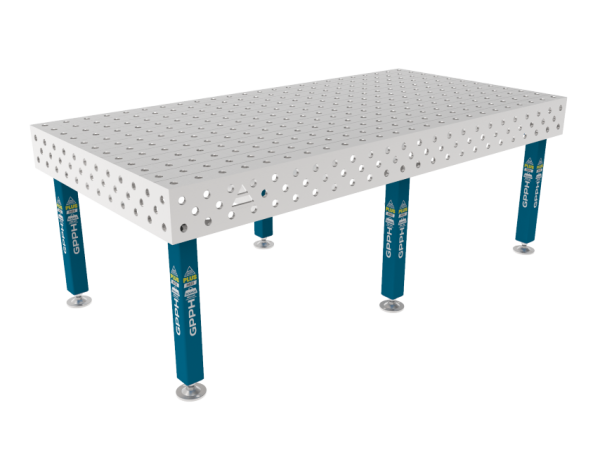
The right welding table should be selected according to the size of the fabrication, the tooling system, the clamping method, and the available workspace. Traditional welding tables are available in 10 sizes ranging from 1000 × 600 mm to 3000 × 1480 mm, with the largest version consisting of two 1500 × 1480 mm tabletops. The table should provide sufficient space for tooling and reference points, while the engraved 100 × 100 mm grid helps maintain accurate workpiece positioning.
When choosing a configuration, it is worth comparing traditional welding tables with welding and assembly tables. Assembly table variants are ideal where unrestricted access without side walls is required, while for a more limited budget, a good starting point may be SMART welding tables. Before making a selection, you should also verify that the hole system is compatible with the tooling you use.
Ergonomics and mobility of welding tables
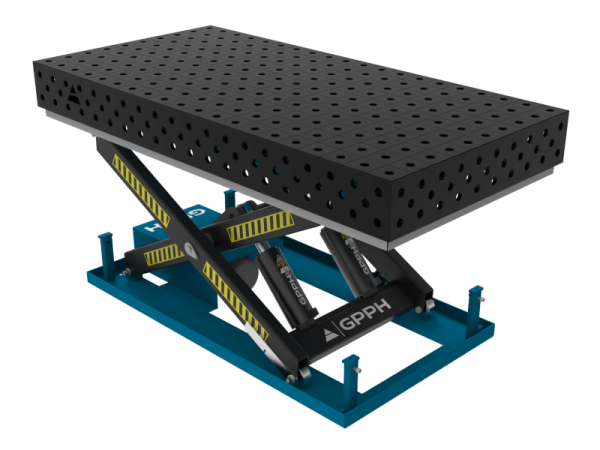
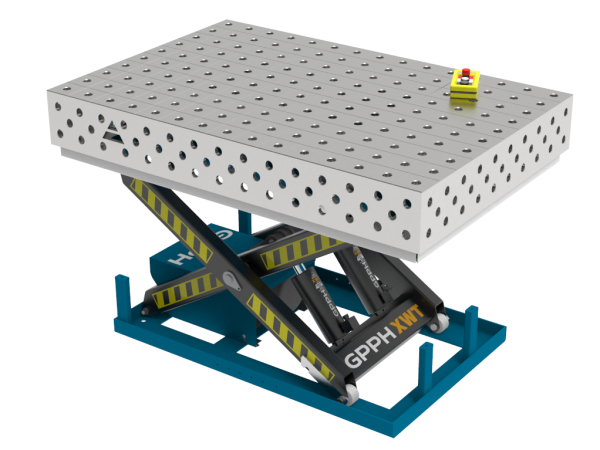
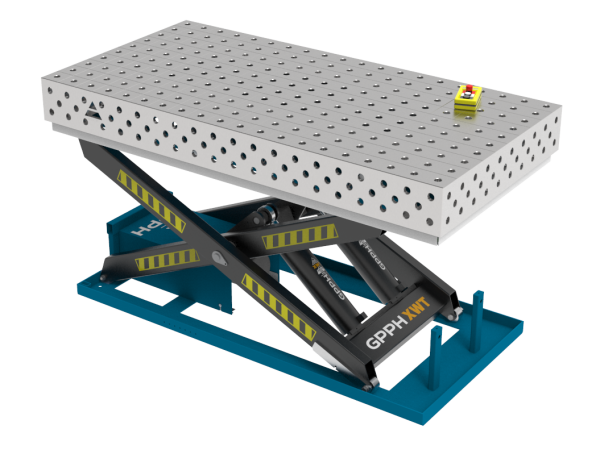
Ergonomics and working comfort improve when the table height and mobility match the workstation layout. Tables can be equipped with leveling feet or mobile casters, but the level should be checked again after every relocation. For tasks performed at different working heights, it is worth considering height-adjustable welding tables, which allow the tabletop height to be adjusted to the operator, the type of work, and the size of the workpiece. Mobility should never come at the expense of stable support at every contact point.
When should you choose a stainless steel welding table?
A welding table made of 1.4301 stainless steel is worth choosing for welding stainless steel components, as the material reduces the risk of surface contamination with carbon steel particles. Category stainless steel welding tables The stainless steel welding table range includes the PLUS INOX model with a 12 mm tabletop and the PRO INOX model with a 15 mm tabletop. The flatness tolerance across the entire tabletop is ≤ 0.3 mm (less than or equal to 0.3 mm) when the table is properly leveled.
Tabletops with thicknesses of 8, 12, 15, or 25 mm and Ø16 and Ø28 mm hole systems allow you to choose a welding table that matches the geometry of your workpieces, your clamping method, and the tooling you use. Compare the GPPH range and configure your workstation for your welding applications.
Frequently Asked Questions
Ø16 or Ø28 mm holes - which should you choose?
The Ø16 mm system is ideal for smaller, precision workpieces, while the Ø28 mm system is better suited for larger structures and heavier-duty tooling.
Does a welding table need to be leveled?
Yes. Proper leveling allows you to achieve the declared tabletop flatness tolerance and maintain the geometry of the structure.
Do you need a stainless steel tabletop for stainless steel?
The INOX tabletop made from 1.4301 stainless steel is designed for stainless steel fabrications and reduces their contact with carbon steel. You can also take advantage of our stainless steel cover plates for a welding table.

 Polski
 Čeština
 English (UK)
 English
 English (Australia)
 English (South Africa)
 English (New Zealand)
 Deutsch
 Deutsch (Österreich)
 Deutsch (Schweiz)
 Español
 Español de Costa Rica
 Español de Guatemala
 Español de Puerto Rico
 Español de Chile
 Español de Uruguay
 Español de República Dominicana
 Español de Perú
 Español de Colombia
 Español de Ecuador
 Español de Argentina
 Español de México
 Español de Venezuela
 Italiano
 Nederlands
 Français
 Français de Belgique
 Français (Algérie)
 Svenska
 Slovenščina
 Slovenčina
 Suomi
Suomi
 Norsk bokmål
 Português
 Português do Brasil
 Dansk
Dansk
 Eesti
Eesti
 Lietuvių kalba
 Latviešu valoda
 Magyar
 Română
 Türkçe
 Ελληνικά
 Українська
 Bahasa Indonesia
 Български
 Hrvatski
 Српски језик