Polski
Čeština
English (UK)
English
English (Australia)
English (South Africa)
English (New Zealand)
Deutsch
Deutsch (Österreich)
Deutsch (Schweiz)
Español
Español de Costa Rica
Español de Guatemala
Español de Puerto Rico
Español de Chile
Español de Uruguay
Español de República Dominicana
Español de Perú
Español de Colombia
Español de Ecuador
Español de Argentina
Español de México
Español de Venezuela
Italiano
Nederlands
Français
Français de Belgique
Français (Algérie)
Svenska
Slovenščina
Slovenčina
Suomi
Norsk bokmål
Português
Português do Brasil
Dansk
Eesti
Lietuvių kalba
Latviešu valoda
Magyar
Română
Türkçe
Ελληνικά
Українська
Bahasa Indonesia
Български
Hrvatski
Српски језик

For years, one silent assumption prevailed in many workshops: it is the welder who must adapt to the workstation. If the worktop is too low – you have to bend down. If it’s too high – work with raised arms. If there isn’t enough space – “you somehow make it fit.”

We’ve been waiting for spring!
Week 12 of the year is the moment when days become noticeably longer, there is more daylight, and the energy to act returns with double strength.

Every welder works a little differently. One prefers heavy steel and a reserve of power, another focuses on precision, and a third simply wants the job to run smoothly without unnecessary complications.

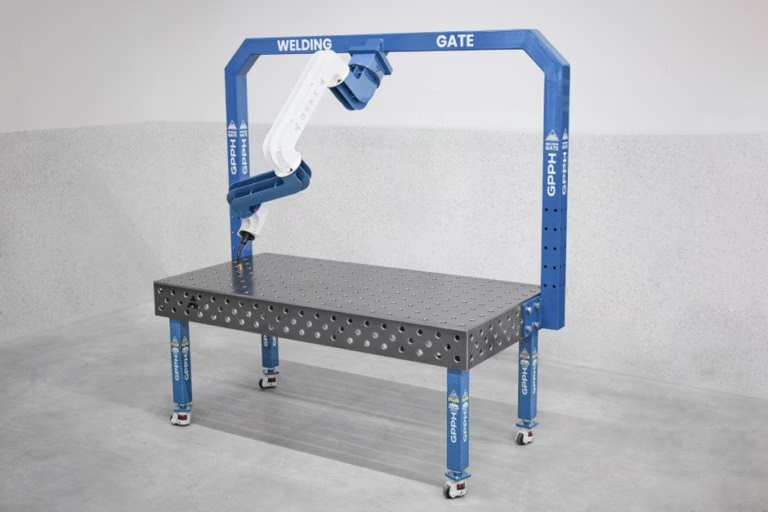
The automation of welding processes is no longer the exclusive domain of large manufacturing plants. More and more companies are deciding to implement cobots, i.e. collaborative robots that can work side by side with humans.

A welder rarely calls himself a perfectionist. More often, he says “that’s how it should be” or “there’s no other way.” And yet – just look at his workstation, the way he sets up components, or his reaction to the slightest deviation to know one thing: perfectionism in welding is part of everyday life.

Poprawa bezpieczeństwa i higieny pracy to dziś nie tylko obowiązek pracodawcy, ale także inwestycja w zdrowie pracowników i efektywność operacyjną firmy. W 2026 roku Zakład Ubezpieczeń Społecznych ponownie uruchomił konkurs dofinansowań, który ma na celu ograniczenie zagrożeń w miejscu pracy, redukcję wypadków oraz poprawę ergonomii na stanowiskach.

Limited floor space is one of the biggest challenges in welding workshops. Lack of space quickly affects ergonomics, working time and safety. Fortunately, a well-planned workstation allows you to get the most out of even a small area.

Modern welding is increasingly less associated with a single, permanently assigned workplace.

In many workshops, a welding table is treated solely as a work surface. In modern production processes, however, it is a system component that has a direct impact on lead time, repeatability of structures, and the welder’s working comfort. An improperly set up or poorly selected table not only slows down work, but very often generates errors that only become apparent during assembly or quality control.

If you enjoy DIY, welding, experimenting and “doing things your own way”, then you know one thing for sure – a good workshop table is essential.
GPPH S.C. © 2025 All rights reserved.
Podaj swój adres e-mail, aby zachować zawartość koszyka i wrócić do zakupów w dogodnym momencie.