


Getting started in welding can be demanding. Even after completing a course or obtaining initial certifications, a young welder faces the reality of production work. In theory, everything seems simple – in practice, mistakes appear that affect the quality of the structure, its geometry, and the pace of work.
What are the most common mistakes made by beginner welders? And can a properly selected welding table and workstation equipment really help reduce them?
Below, we outline five issues that most often arise at the beginning of a professional journey – and show how GPPH’s professional solutions help minimize them.
1. Unstable clamping of elements
One of the most common mistakes beginner welders make is insufficiently securing the parts before starting work. The elements are “tacked” in place provisionally, without precise positioning and proper clamping force.
The result?
- shifts during welding,
- distortion of the structure,
- lack of repeatability,
- the need for rework.
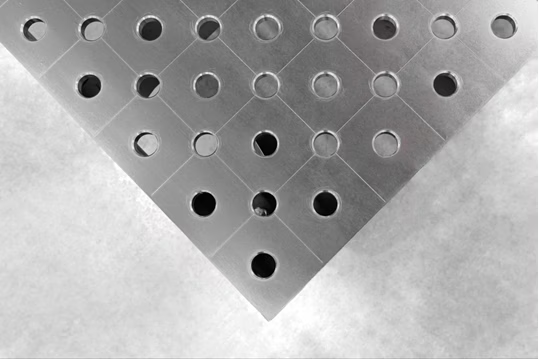
Proper clamping starts with a stable foundation. GPPH welding tables equipped with a Ø16 or Ø28 hole system – in 100x100 mm, 50x50 mm grids and a diagonal layout – allow for precise positioning of elements and maintaining the geometry of the structure. Combined with clamps, fast assembly bolts and prisms, they provide full control over the workpiece even before the first arc is struck.
For a beginner operator, this is a huge support – it reduces the risk of errors resulting from a lack of experience.
2. Working in a non-ergonomic position
Another common issue is an improperly adjusted welding table height. A tabletop that is too low forces a hunched posture, while one that is too high causes strain in the shoulders and wrists.
Konsekwencje są poważniejsze, niż mogłoby się wydawać:
- faster fatigue,
- decreased precision,
- back pain,
- more mistakes at the end of the shift.
That’s exactly why workstation ergonomics is crucial, especially for young welders who are still building their habits. GPPH XWT lifting tables with a hydraulic height adjustment system allow the tabletop level to be tailored to the operator’s height and the type of structure being fabricated. Height adjustment is not a luxury – it’s a tool that improves focus and work quality. The less fatigue, the better the control over the weld.
3. Underestimating the importance of ventilation
Young welders often overlook the fume extraction system. Meanwhile, a smoke-filled workstation reduces the visibility of the weld pool and lowers overall working comfort.
Lack of proper fume extraction can lead to:
- problems with concentration,
- affects the precision of the structure’s execution
- a risk to health.
At the workstation level, solutions such as IQ Air Flow systems evenly extract fumes from the entire table surface. Combined with IQ AeroClean or IQ AeroClean ECO units, they ensure effective air filtration directly at the source of contamination.
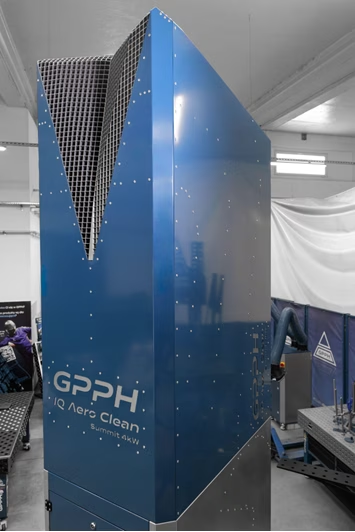
In larger spaces, IQ Aero Clean SUMMIT proves effective – an industrial filtration column that purifies the air throughout the entire hall, especially where ducting systems are not available.
For facilities requiring continuous operation, the IQ Aero Clean MASTER unit is designed – a high-performance solution for servicing larger work zones and central installations. Properly selected ventilation means clean air, better visibility, and greater precision of work.
4. Organizational chaos at the workstation
A beginner welder often focuses solely on technique, ignoring workplace organization. Tools are placed in random locations, clamps lie on the tabletop, and accessories get mixed with the workpieces.
This leads to:
- time lost searching for elements,
- unnecessary downtime,
- a higher risk of equipment damage.
Profesjonalne wyposażenie stanowiska spawalniczego znacząco ogranicza ten problem. Systemy takie jak WeldStation z szufladami o dużej nośności, półki dolne montowane pod stołem czy wózki narzędziowe GPPH umożliwiają logiczną organizację przestrzeni roboczej.
Order directly impacts productivity. Every minute saved translates into a higher number of completed jobs.
5. Mismatch between the table and the type of production
The final, often overlooked mistake is working at a workstation that does not match actual production needs. A table that is too light for heavy structures or an overly complex setup for simple assembly tasks creates organizational and cost-related issues.
GPPH offers a wide range of welding table series:
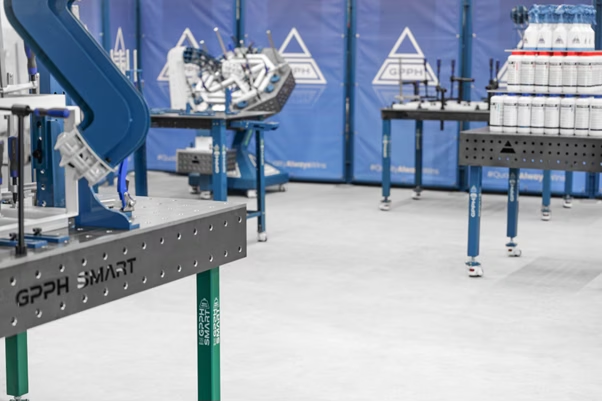
- SMART – a cost-effective solution for lighter tasks,
- PRO and PLUS – professional tables with high precision and versatility,
- EXPERT – for heavy structures requiring maximum rigidity,
- MWT – modular tables with expansion capability,
- OCT – solutions tailored for automation and robotics.
Choosing the right welding table directly impacts stability, repeatability, and overall efficiency.
Does equipment really influence the development of a beginner welder?
Yes – and more than you might expect.
Stabilny stół GPPH , ergonomiczna wysokość, systemowe mocowanie i uporządkowane stanowisko sprawiają, że młody operator może skupić się na technice, a nie na walce z niedoskonałościami środowiska pracy.
Equipment won’t replace experience. But it can significantly reduce the number of mistakes, shorten the learning curve, and accelerate skill development.
Summary
The most common mistakes of beginner welders are:
- lack of stable clamping of elements,
- working in a non-ergonomic position,
- chaos at the workstation,
- ignoring ventilation,
- a table not suited to the type of work.
Lack of experience is a natural part of learning the trade. However, with a poorly designed workstation, even minor mistakes can escalate and negatively affect the quality of the structure.
Therefore, a modern welding workshop should combine skill development with properly selected equipment. Comprehensive GPPH solutions – from welding tables, through clamping systems, accessories and tools, welding chemicals, filtration and ventilation systems, to complete welding stations and modular solutions – facilitate daily work, streamline the production process, and can significantly improve the quality of manufactured structures. Because experience is gained over time, but a well-designed workstation supports the operator from day one and helps reduce errors.